

Asia-Pacific Integrity School
Ended Sep 5, 2026
Sorry! The enrolment period is currently closed. Please check back soon.
Full course description

Enrolment
Applications have now closed. To lodge a late expression of interest, please fill out the following Expression of Interest form, and we will notify you if a place becomes available, or put you on the mailing list for next year's Asia Pacific Integrity School.
If we have notified you by email that you have a confirmed place in the course, you can enrol above. Enrolment and payment are required by 31 August 2026.
About this course
The Asia Pacific Integrity School is a 6-day intensive program in Brisbane, Australia, equipping early to mid career professionals and young people from all sectors of society with policy, analytical and operational knowledge to lead and implement integrity and anti-corruption measures in institutions and societies across the Asia Pacific region.


A partnership between Griffith University and Transparency International chapters across the Asia-Pacific region, the Integrity School is supported by Australia Awards Indonesia (Department of Foreign Affairs and Trade) and the United Nations Office on Drugs and Crime.
The Asia-Pacific Integrity School is especially designed for:
- Young professionals starting out, planning or transitioning to a career in public integrity agencies or programs
- Rising organisational leaders and governance professionals seeking to make a difference in the integrity, transparency, accountability and compliance systems of their institutions (public or private sector)
- Civil society members, policy makers and development workers seeking to deepen their skills and networks in anti-corruption and good governance reforms.
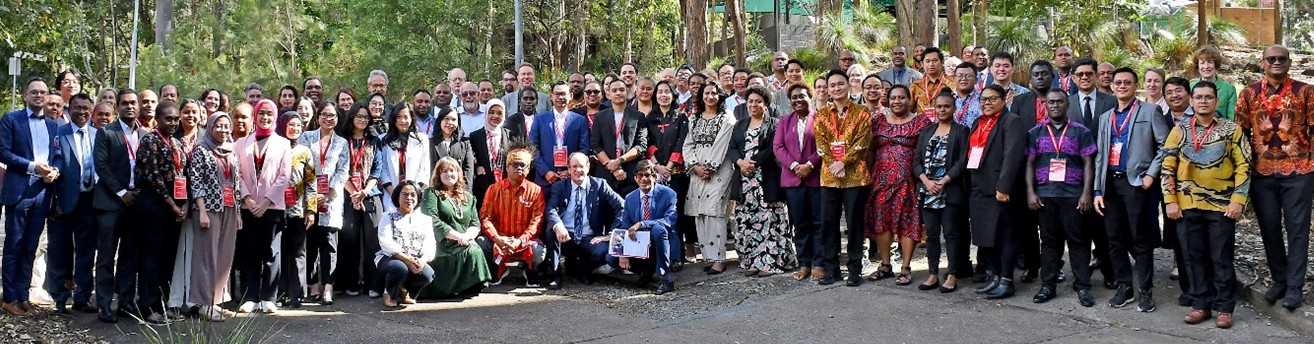
The 6 days include guest speakers, workshops, interactive sessions, institutional visits and networking and group learning opportunities
Participants receive learning recognition in the form of a verifiable Griffith University Digital Badge micro-credential, or recognition via other Griffith University postgraduate courses as applicable, including the Master of Public Policy & Leadership, and the Master of Global Development.
Discount
Civil Society Discount: 50% off full price
Expressions of Interest
Step 1 : Please fill out the following Expression of Interest form by 17 July 2026. Places are limited, so please apply early!
Step 2: Successful applicants will be notified by email, and asked to enrol above. Enrolment and payment will be required by 14 August 2026.


Course Snapshot
After completing this course, you will be able to:
- Apply foundational knowledge of international and Australian efforts to combat corruption and promote transparency, integrity and accountability in government and business, including the principles, institutions, systems and processes that underpin these efforts
- Apply enhanced skills in ethical/professional judgment relevant to assessment, investigation, prevention and other professional roles and responsibilities in integrity/anti-corruption decision-making and operations
- Build stronger networks and skills for interdisciplinary and inter-institutional collaboration and teamwork in your country’s or organisation’s integrity system, including with professionals from other functional areas, agencies, sectors and societies.
Over the 5 main days, the course covers topics including:
- Integrity and Corruption: Trends, Challenges & Responses
- Understanding the Integrity System: Roles & Responsibilities
- Strategic Challenges for Integrity Professionals: Independence, Collaboration and Reform
- Integrity Skillsets: Investigations, Financial Forensics, Organisational, Policy, Legal, Leadership
- Social Accountability, Media and the Community
- Protecting Stakeholders: Whistleblowers, Witnesses & Complainants
- Oversight, Accountability and Professional Ethics
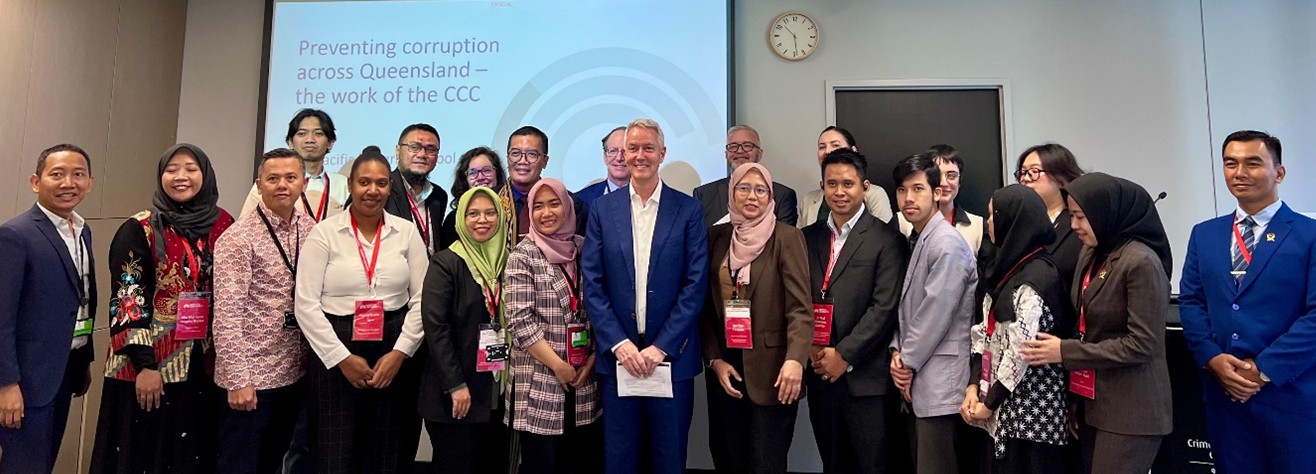
The course also includes institutional visits to the Queensland Crime & Corruption Commission, Supreme Court of Queensland, Queensland Parliament, and guest lectures from national and international integrity experts (see ‘who are the course facilitators?’ below)
The course includes a welcome reception, Indigenous Australian welcome to country ceremony, official dinner, certificate presentation event and local cultural and environmental field excursion.
The Asia-Pacific Integrity School is especially designed for:
- Young professionals starting out, planning or transitioning to a career in public integrity agencies or programs
- Rising organisational leaders and governance professionals seeking to make a difference in the integrity, transparency, accountability and compliance systems of their institutions (public or private sector) and their country
- Civil society members, policy makers and development workers seeking to deepen their skills and networks in anti-corruption and good governance reforms.
Participants will receive a digital badge. Griffith University postgraduate students enrolled in the Master of Public Policy and Leadership, Master of Global Development, or other programs, can also participate in the Integrity School for full academic credit by enrolling in 7013GIR Integrity and Anti-Corruption: Professional Foundations (Mixed Mode).
You will need to attend seminars, workshops and site visits over a 5-day period (Monday-Friday), from 9 a.m. to 5 p.m. on our Brisbane South (Nathan) campus and locations around Brisbane City, plus an induction reception on Sunday 30 August, an official dinner on Tuesday 1 September, and a final day-long group networking excursion to the Gold Coast on Saturday 5 September.
Course leader:
 Professor A J Brown AM, Professor of Public Policy & Law, Griffith University
- Chair, Transparency International Australia
- Member, Queensland Government Public Sector Governance Council
- Former senior investigator, Commonwealth Ombudsman (Australia)
A J Brown is a 30-year veteran of developments in public integrity systems, having worked or consulted in all levels and branches of government in Australia, including as a senior investigator for the Commonwealth Ombudsman. He was a member of the Commonwealth's Ministerial Expert Advisory Panel on Whistleblower Protection (2017-2019), and in 2024, was appointed to the Public Sector Governance Council of Queensland. He has led seven Australian Research Council projects into public integrity and governance reform, including a current $1.2 million Australian Research Council Discovery project on public trust, mistrust and distrust. He is a past President of the Australian Political Studies Association (2017-18), and a Fellow of the Academy of Social Sciences in Australia, and Australian Academy of Law. In 2023, he was made a Member of the Order of Australia for services to the law and public policy, particularly through whistleblower protection. AJ has served on the Transparency International Australia board since 2010, as well as on the TI global board of directors (2017-2023). In 2019-20, he led development of TI's world strategy 'Holding Power to Account, 2021-2030'.
Guest presenters:
 Maira Martini (Brazil), Chief Executive Officer, Transparency International
Maíra Martini is the Chief Executive Officer of Transparency International. Prior to that she was the organisation’s Head of Policy and Advocacy. An expert on corrupt money flows, she has led Transparency International’s efforts on anti-money laundering, beneficial ownership transparency, and combating illicit financial flows for many years. A lawyer and certified anti-money laundering specialist, she also holds a Masters in Public Policy from the Hertie School of Governance in Berlin. Throughout her career, Maíra has authored numerous reports and analyses on anti-corruption and good governance. Additionally, she serves on the Steering Groups of OpenOwnership and the AntiCorruption Data Collective, initiatives focused on enhancing transparency and combating corruption. In recognition of her contributions, Maíra was awarded the 2022 Amalia Award for Professional Excellence by Transparency International.
Iain Anderson, Commonwealth Ombudsman (Australia)

Mr Anderson was appointed as the Commonwealth Ombudsman from 1 August 2022 for a 5-year term. As the Commonwealth Ombudsman, Mr Anderson is also the ACT, Defence Force, Immigration, Law Enforcement, National Student, Private Health Insurance, Overseas Student, VET Student Loan and Postal Industry Ombudsman. He is also the Commonwealth National Preventive Mechanism under the Optional Protocol to the Convention Against Torture. As a senior public servant with extensive leadership experience and over 35 years of service, Mr Anderson has developed and implemented transformational change across a wide range of legal and social policy areas, including the Commonwealth civil justice and criminal justice systems, family law, native title, Royal Commissions and Australia's territories. Mr Anderson's experience extends across a variety of Commonwealth departments and agencies and across a wide range of legal and social policy areas. Mr Anderson holds a Bachelor of Economics and a Bachelor of Laws from the University of Sydney.
Bruce Barbour, Chairperson, Crime & Corruption Commission, Queensland

Mr Barbour commenced as Chairperson on 2 July 2022 for a three-year term and was reappointed on 22 May 2025 for a further term until 1 July 2028. He was previously a part-time Ordinary Commissioner of the CCC from May 2021 to January 2022, and was appointed the Acting Chairperson from 28 January 2022 to 1 July 2022. Mr Barbour has extensive experience in administrative law, investigations and management. He was the NSW Ombudsman for 15 years from 2000 to 2015. Mr Barbour has also been a Senior Member of the Administrative Appeals Tribunal, Member of the NSW Casino Control Authority and acted as Commonwealth Merit Protection Commissioner and Queensland Integrity Commissioner. His board experience includes being Chair of the NSW Public Interest Disclosures Steering Committee, Convenor of the NSW Child Death Advisory Committee and Vice-President of the International Ombudsman Institute. He holds a Bachelor of Laws from Sydney University and was admitted as a Legal Practitioner to the Supreme Court of NSW in 1995.